Over the last 11 years, I have coached hundreds of startup founders launching companies across every industry imaginable. That experience has given me a front row seat to the very real challenges that founders face, especially in the early-stage.
Despite the abundance of advice in the startup ecosystem, most startups fail. Founders have too many variables, insufficient context, and even seasoned entrepreneurs get overwhelmed and frustrated. Witnessing this constant struggle for effectiveness has driven me to develop my own definition for Venture Design and a Venture Design framework to help founders more effectively navigate the complexities of the early-stage.
This definition is important because it begins the scope of what the founder needs to design. Most founders struggle with adequately describing the company they see in their mind's eye. You need both a model and a story to describe the future company you are imagining. The better you can model it, the better chance someone else can follow your thought process.
Without Venture Design, the closest thing we have to modeling this well enough and attempting a complete story is the standard pitch deck template. This has been the primary tool for founders to externalize and organize their thinking about all of the various dimensions of their venture. When founders identify a compelling new insight, the first thing they do is go update their pitch deck.
While this is not wrong, it is also not enough. I say this because most pitch decks don’t work. A compelling pitch deck is simply an expression of a well-constructed model. With Venture Design, we now have tools that directly address the underlying components of your model. If you do this foundational set of homework, crafting a pitch deck will be a natural expression of what you already know, not a creative writing exercise.
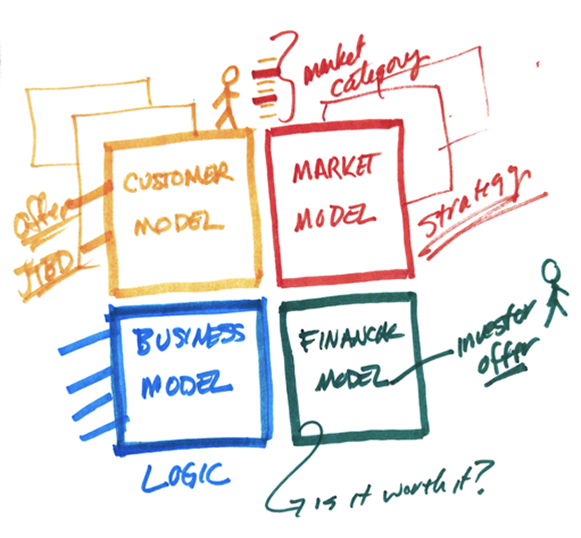
In my role as a Founder Performance Coach, I provide a purpose-built framework and tool set that increases founder competency and empowers them to translate what’s in their head into real-world action. Using Venture Design, founders can organize all of their various assumptions and opportunities into a cohesive Venture Design Model.
My Venture Design Model framework is underpinned by 4 core components, each of which has its own related set of tools.
Venture Design offers founders a way to structure their thoughts. It gives founders a context for decision-making and lets them more effectively prioritize actions that will actually create progress today. In particular, it empowers founders to identify which of their core assumptions pose the greatest risk and focus their efforts on grounding those assumptions in reality.
I have seen founders gain 3 primary benefits from undertaking a rigorous Venture Design approach.
1. Clarity
Venture Design gets everything out in the open and inside of a structured framework that allows founders to choose between options that have been unclear or hidden.
2. Competence
When founders learn to use Venture Design tools, they are able to ask the right questions, reduce risk in their core assumptions, and operate with higher precision.
3. Confidence
The choice to become a founder can be a daunting one. Venture Design allows you to step into the role with clear direction, purpose, and next steps.
If you want to learn more about Venture Design and how you can apply it to the specific challenges you are facing right now, click the button below to schedule a call.